Office
NO,46, 50ft Road, Rajeev Gandi Circle Laggere
Bengaluru , karnataka
India (560058)
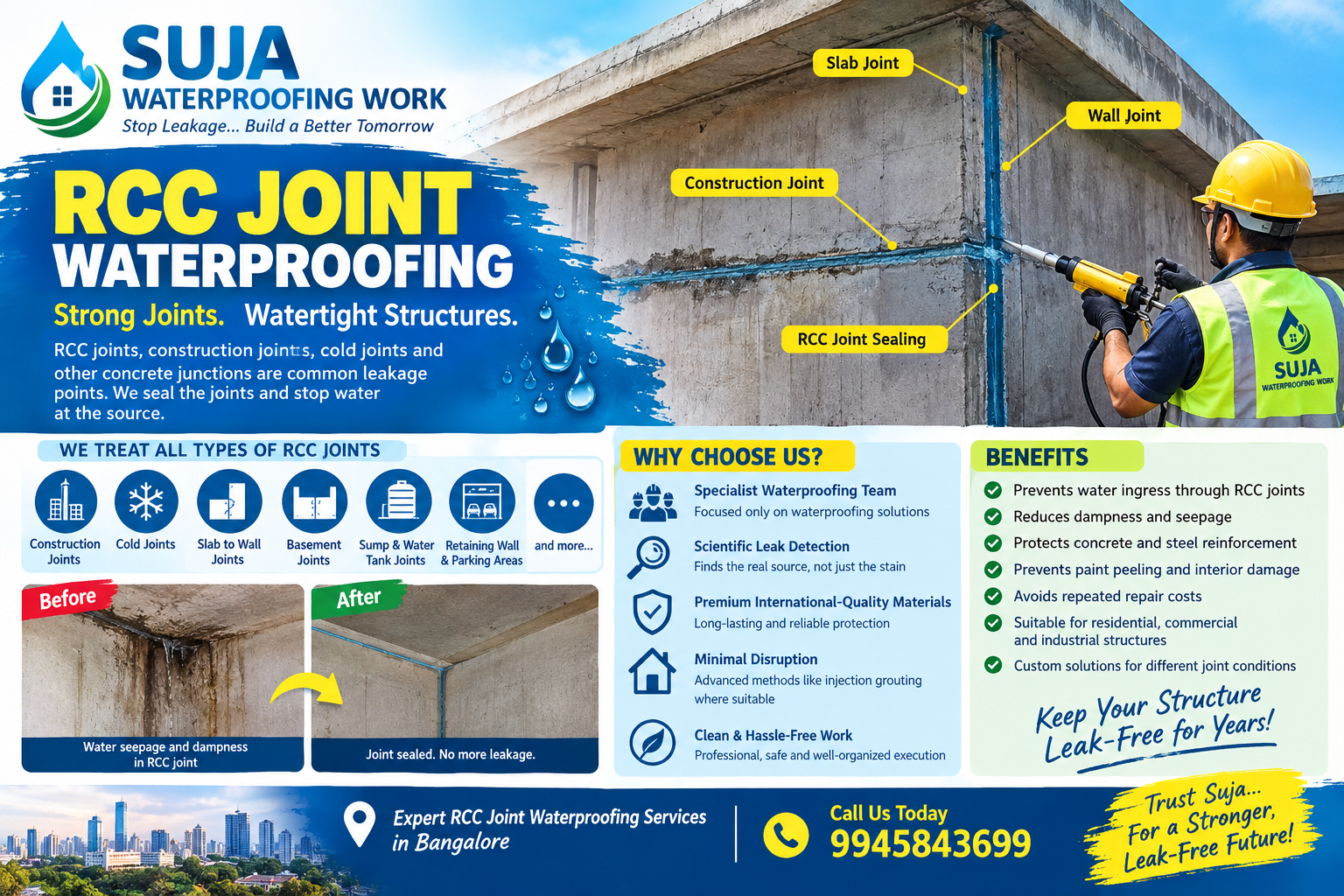
RCC Joint Waterproofing is an important waterproofing treatment for preventing water seepage through joints and junctions in reinforced cement concrete structures. Construction joints, cold joints, slab-to-wall junctions, basement joints and other RCC connections can become vulnerable points for water entry when they are not properly treated.
When water finds a pathway through an RCC joint, it can lead to damp patches, peeling paint, efflorescence, unpleasant moisture, ceiling leakage and repeated repair problems. Government waterproofing guidance also identifies joints as vulnerable areas where water can penetrate and recommends appropriate treatment of RCC cold joints.
At Suja Waterproofing Work, we focus on identifying the actual leakage pathway before selecting the waterproofing treatment. Depending on the condition of the joint, location and water pressure, the solution may involve joint preparation, sealing, PU injection grouting, suitable waterproofing compounds, flexible joint treatment or a combination of methods.
Our objective is not simply to cover the visible leakage. We work to treat the joint through which water is entering and provide a suitable long-term waterproofing solution.
RCC joint waterproofing can be required in:
Water entering through RCC joints may cause:
The correct treatment depends on whether the joint is a construction joint, cold joint, movement/expansion joint or another type of concrete junction. Different joint conditions require different waterproofing approaches.
We first inspect the affected area and study the location and pattern of water seepage.
Instead of treating only the visible damp patch, we try to identify the actual water pathway and joint responsible for the leakage.
Loose material, dirt, weak concrete and unsuitable surface material are removed as required before treatment.
Depending on the site condition, suitable techniques may include PU injection grouting, joint sealing, waterproofing compounds, flexible joint treatment or other compatible systems.
The selected waterproofing system is applied carefully to the affected RCC joint to restrict further water penetration.
After treatment, the repaired area is checked and finished appropriately so that the waterproofing work integrates with the surrounding structure.
Our team focuses on waterproofing and leakage-related problems rather than applying the same treatment to every site.
We study the leakage pattern and likely water pathway before recommending a solution.
We select suitable waterproofing materials based on the application, joint condition and site requirements.
Our focus is on addressing the source of water ingress rather than simply hiding the visible stain.
Where technically suitable, injection and joint-treatment methods can help address leakage without unnecessary breaking of existing finishes.
We aim to complete the waterproofing work systematically while keeping the surrounding area as clean and manageable as possible.
At Suja Waterproofing Work, we believe that every leakage has a reason. A damp patch on a wall or ceiling may only be the visible symptom, while the actual water pathway can be located somewhere else.
That is why our approach begins with understanding the structure, identifying the vulnerable joint and selecting a waterproofing method suitable for the actual site condition.
We work with a focus on proper diagnosis, suitable materials, skilled application and long-term protection.
Whether you are facing leakage in a basement, terrace, retaining wall, sump, lift pit, parking area or RCC structure, our team can inspect the affected area and recommend a suitable waterproofing solution.
Don't wait for a small RCC joint leak to become a recurring waterproofing problem. Get the joint inspected and choose the right waterproofing